
If you’ve been hurt by someone you love, whether through a lie, a hidden secret, an emotional disconnection, or something that cut you to the core, you may be wondering whether what you had can ever be salvaged. Betrayal in a relationship can feel like the ground has shifted beneath you. And it doesn’t have to involve an affair to devastate you.
The pain you’re feeling is real, and it makes complete sense. Betrayal, in all its forms, can fundamentally alter how safe you feel with your partner. But here’s what I want you to know: trust can be rebuilt. With clarity, accountability, and genuine effort from both partners, relationships do heal.
Whether you’re the one who caused the hurt or the one who’s carrying it, this guide is for you. Drawing from Emotionally Focused Therapy (EFT) and the science of attachment, we’ll walk through what betrayal really is, what repair actually requires, and how to begin moving forward, together.
What “Betrayal” Really Means (Beyond Infidelity)
Most people associate betrayal with cheating. But in reality, trust can be broken in many ways, and all of them hurt.
In Emotionally Focused Therapy, we talk about something called an “attachment injury,” a moment when you needed your partner and they weren’t there for you, either physically or emotionally (Johnson 2008). These injuries can include:
- Emotional affairs or secretive online relationships
- Financial infidelity: hidden debt, secret spending, or undisclosed accounts
- Significant lies or ongoing deception
- Emotional withdrawal during a critical moment (a miscarriage, illness, a traumatic experience)
- Broken promises that repeatedly go unaddressed
- Stonewalling or shutting down instead of showing up
In my book Help for High-Conflict Couples, co-authored with Jacqueline Wielick, we describe it this way:
"An attachment injury is a sense of betrayal and/or abandonment within your bond with your partner that occurs during a critical moment when you needed them and they weren’t there for you."
Estes Powell & Wielick, Help for High-Conflict Couples Tweet
The wound doesn’t have to be dramatic to be real. Sometimes the most painful betrayals are the quiet ones—the slow erosion of trust through secrecy, withdrawal, or broken agreements. Whatever you’ve experienced, your pain is valid, and healing is possible.
Related Reading:
- What Is an Emotional Affair?: https://estestherapy.com/relationship-advice-what-is-an-emotional-affair/
- Why Stonewalling Damages Relationships :https://estestherapy.com/storming-out-of-fights-heres-why-you-need-to-stop
What Trust Repair Actually Requires
Let me be honest with you: there is no quick fix for a broken bond. Rebuilding trust after betrayal is a process, and it requires specific ingredients from both partners.
In Emotionally Focused Therapy, research by Dr. Sue Johnson and Judy Makinen (2006) identifies four core elements required for successful attachment injury recovery:
- A shared understanding of what happened: both partners must get on the same page about the injury.
- Understanding the impact: genuinely recognizing how the event affected the hurt partner and the relationship.
- Processing the emotions: moving through the deeper feelings, not just managing surface behavior.
- Creating a corrective emotional experience: a new, healing moment together that wasn’t available at the time of the injury.
Beyond these steps, meaningful repair also requires:
- Transparency and honesty going forward
- Consistent behavior that matches your words
- Patience: healing is not linear
- Emotional safety for both partners
As I often tell the couples I work with: trust can’t be rebuilt on faith alone. It has to be experienced. And that requires both of you to show up, consistently, over time.
"Trust can’t be built on faith that things will change; like all change, it has to be experienced.”
Estes Powell & Wielick, Help for High-Conflict Tweet
Steps for the Partner Who Broke Trust
If you are the one who caused the hurt, the path forward begins with one thing: taking full responsibility—without defensiveness, without minimizing, and without making it about your own shame or discomfort.
This is hard. I know. But here’s what genuinely helps:
1. Own It—Completely: Partial admissions, excuses, and “yes, but” statements don’t repair trust. They deepen the wound. In my book, we outline what a genuine disclosure looks like, including being the one to share the truth yourself, validating your partner’s gut feelings if they had them, and releasing all the information at once rather than letting it “dribble out” over time. Each new revelation reopens the injury.
"Your words have lost their value and you can no longer provide your partner with reassurance in this way, so your behaviors must send the same message to help your words regain value.”
Estes Powell & Wielick, Help for High-Conflict Couples Tweet
2. Validate the Hurt Without Defending Yourself: EFT teaches us that one of the deepest needs we have is to feel seen, heard, and understood by our partner, especially in our pain. When your partner shares how betrayed they feel, resist the urge to explain or justify. Simply be with them in it.
A genuine apology, in EFT terms, goes far beyond “I’m sorry.” It shows that you understand why your partner is hurting, and that their pain matters to you. As we put it in Help for High-Conflict Couples, a heartfelt apology sends the message: “I see you, I hear you, and I understand.”
3. Be Transparent and Answer Questions Honestly: Your partner may need to ask the same questions multiple times. This isn’t about punishing you, it’s about trying to make sense of something that shattered their sense of reality. Stay available. Stay honest. Transparency is a cornerstone of rebuilding safety.
4. Demonstrate Change Through Consistent Action: Words are no longer enough. What repairs trust now is behavior; reliable, consistent, and aligned with what you say. Over time, this consistency is what gives your partner their safety back.
Steps for the Hurt Partner
If you’re carrying the weight of betrayal, I want to start by saying: you are not responsible for fixing this alone. The repair work belongs to both of you. And while your partner must demonstrate change, there are things you can do to support your own healing.
1. Give Your Feelings a Voice: Safely: The hurt you’re holding is real, and it needs to be expressed. EFT teaches us that when we stay stuck in “secondary” emotions—the anger, the sarcasm, the shutting down—we rarely access the deeper, primary feelings underneath: the fear, the sadness, the longing to feel safe again. When you can begin to access and share those softer emotions, it opens a door that defensiveness cannot.
This doesn’t mean you have to keep it calm when you’re not. It means working toward expressing what’s underneath the anger so your partner can actually hear you.
2. Set Boundaries That Protect Your Emotional Safety: Healing cannot happen in an unsafe environment. A rupture to a relationship causes a traumatic response. You have the right to set clear, reasonable boundaries around what you need in order to feel safe. In Help for High-Conflict Couples, we introduce what we call the “Safety Sandwich”—a three-part structure for communicating a boundary in a way that’s firm but doesn’t escalate conflict:
- An opening statement that validates your partner
- The boundary itself, stated clearly and without blame
- An alternative that keeps the door open for connection
For example: “I know you want to talk through this. I need us to pause if voices get raised—I can’t hear you when I’m flooded. Let’s agree to take a break and come back within the hour.”
3. Ask for What You Need to Feel Secure Again: Repair requires you to be honest about what will help you feel safe. More transparency? Regular check-ins? Less time on devices? Whatever it is, naming it gives your partner a concrete way to show up for you.
And please remember: you don’t have to “just get over it.” Unresolved wounds don’t disappear; they go underground and fuel conflict. Healing happens when the wound is properly tended to, not bypassed, with healthy boundaries and positive experiences.
“Emotional wounds are similar to physical cuts. A large scrape or gash must be tended to properly if it’s to heal correctly; otherwise, it continues to bleed.”
Estes Powell & Wielick, Help for High-Conflict Couples Tweet
Rebuilding Trust Together
Here’s the most important thing I want to leave you with: you cannot rebuild trust alone. And you are not meant to.
EFT research is clear that healing from attachment injuries doesn’t happen in isolation—it requires both partners to co-create new, corrective emotional experiences together. These are moments where the relationship gets to write a new story: one where you showed up for each other in ways that weren’t possible before.
What does rebuilding look like in practice? It often includes:
Create New Agreements
What needs to change going forward? What agreements will help you both feel safe? These don’t have to be rigid rules—they’re commitments rooted in care. Transparency about devices, regular emotional check-ins, or a joint agreement to seek couples therapy can all be meaningful anchors.
Rebuild Emotional Intimacy Slowly
Trust is rebuilt through small, consistent moments of connection—not grand gestures. EFT calls this “A.R.E.”: Accessibility, Responsiveness, and Engagement. Are you available to your partner emotionally? Are you responding to their bids for connection? Are you truly present? These qualities are the building blocks of a secure bond.
Track Progress, Not Perfection
There will be hard days. There will be setbacks. This is normal. What matters is the overall direction of your relationship—are you both moving toward each other? Are you repairing after conflict more quickly? Are you feeling incrementally safer?
In my work with couples over many years, I’ve seen time and time again that the relationships that heal are the ones where both people decide—even when it’s hard—that they’re going to fight for the connection, not against each other.
Hurt people heal every day. Hurt relationships heal every day. In these pages, we will walk you toward that healing.”
Estes Powell & Wielick, Help for High-Conflict Couples Tweet
If you’re finding that you and your partner are stuck—that the same cycles keep repeating and the wound doesn’t seem to be closing—it may be time to bring in professional support.
About Jennine
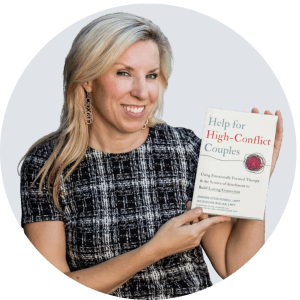
Jennine Estes Powell, LMFT, is the founder of Estes Therapy in San Diego and Oceanside, California. Specializing in Emotionally Focused Therapy (EFT), she has spent decades helping couples repair deep relational wounds and build lasting, secure bonds. She is the co-author of Help for High-Conflict Couples: Using Emotionally Focused Therapy & the Science of Attachment to Build Lasting Connection (New Harbinger Publications, 2024).


